
India has reiterated that any code of conduct for the South China Sea must align with international maritime law, particularly the UN Convention on the Law of the Sea (UNCLOS). This statement comes as China and ASEAN continue negotiations on a pact for the contested region, where concerns over China's expansive claims and military activities persist.

Amid its raging dispute with Japan over the sovereignty of islands in East China Sea, the Chinese military has conducted exercises with amphibious tanks practising stealth landing on the territory.
Indian and the United States navy are conducting their annual amphibious training exercise -- Habu Nag -- in the East China Sea, which is designed to enhance their bilateral interoperability, including humanitarian assistance and disaster response.

China on Wednesday reacted strongly to the Quad Ministerial meeting that voiced serious concerns over the situation in the East and South China Sea, saying they should stop meddling in maritime affairs in its neighbourhood.

China's national observatory issued a red alert -- the highest level in the country's typhoon warning system -- as Typhoon Dolphin hit Zhejiang province on the eastern coast on Sunday afternoon.

China will build its first long-term underwater observation platform in resource-rich South China Sea, where it has territorial disputes with many south-east Asian countries including Malaysia, the Philippines and Vietnam.

The B-1B Lancer bombers from Guam airbase flew over South China Sea on late Thursday as part of operations intended to demonstrate the US commitment to freedom of navigation, the US Air Force said in a statement.

Top Quad leaders announced new initiatives including a maritime surveillance system, military exercise, cable connectivity, and cybersecurity partnership to strengthen cooperation in the Indo-Pacific. They also opposed destabilising actions and economic coercion, reaffirming their commitment to a free and open region.

In response to the Quad ministers' joint statement, China on Tuesday said it opposes the creation of exclusive 'small cliques' and 'bloc confrontation'.

India and Japan have signed a Memorandum of Arrangement on maritime security cooperation, committing to deepen defence ties and oppose unilateral actions that impede freedom of navigation in the Indo-Pacific, a move seen as directed at China's increasing military presence.
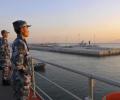
China released a white paper against the UN-backed tribunal's verdict, insisting that Beijing has claims over the strategic region for 2,000 years.

Former US National Security Adviser John Bolton has stated that China is not prepared to back India's bid for a permanent seat on the UN Security Council. He highlighted that any expansion of permanent membership would require a UN Charter amendment, which China could veto. Bolton also discussed the broader institutional challenges facing the UN and suggested that regime change in Iran is crucial for long-term stability in West Asia, linking Houthi attacks to Iran's "ring of fire" strategy.

If Iran and Oman choose to charge a fee for rendering services to vessels using their territorial waters, so be it. The US is indulging in an irrationally self-destructive act, notes Ambassador M K Bhadrakumar.

There have been growing global concerns over China's sweeping claims of sovereignty over all of the South China Sea, a huge source of hydrocarbons.
Declaration by China of a new overlapping Air Defence Identification Zone over contested islands of Diaoyu/Senkaku besides raising tensions between Tokyo and Beijing have caused reverberations in the strategic firmament of the entire Asia-Pacific region.

'After a strategic pause though, Beijing will revive its policy of slowly creeping towards acquiring sovereignty over the South China Sea.'

India has accumulated experience organically and in public, through blood, sweat and toil -- one commissioning and one agreement at a time -- and is called a regional power. China has accumulated hulls, by misdirecting its industrial capacity, and is mistakenly called a superpower. The Indo-Japan defence agreement pushes this theory to its limits without ever naming the dragon in the room, points out Dr Abhishek Puri.

The US, he said, rejects any Chinese claim to waters beyond a 12-nautical mile territorial sea derived from islands it claims in the Spratly Islands (without prejudice to other states' sovereignty claims over such islands).

Gwadar is viewed as a critical pearl in China's maritime strategy as it would give a permanent logistical footprint near an important choke point - the Strait of Hormuz and the oil rich Persian Gulf, explains Commodore Venugopal Menon (retd).
At a time when China's bullying behaviour has been evident in its actions and pronouncements, India is signalling that it is ready to emerge as a serious balancer in East Asia and Southeast Asia, says Harsh V Pant.

The Chinese navy has kicked off 10-day military exercises in the disputed South China Sea amid heightened tensions in the region, especially with the United States.

Saudi Arabia's East-West pipeline shutdown could make crude costlier for India as refiners face fewer supply routes and rising freight and insurance costs.

The Quad grouping has expanded cooperation in critical minerals and energy, while unveiling new measures to boost maritime surveillance and port infrastructure across the Indo-Pacific. This move comes against the backdrop of China's growing military posturing in the region, with ministers reiterating strong opposition to destabilising actions and expressing serious concerns over militarisation of disputed features.

The war of words between China and the US heated up on Tuesday with an American Admiral defending last week's US naval ship's foray near Chinese-made artificial islands in the area while Beijing blasted the move as a "blatant provocation".

Three naval ships of China's Nanhai Fleet left a naval port in Sanya, Hainan Province on Wednesday, kicking off an annual combat drill in the South China Sea, East Indian Ocean and West Pacific, state-run Xinhua news agency reported.

It was clear in Brunei at the 8th East Asia Summit that China doesn't want the South China Sea issue to even dominate the discussion, reports Sheela Bhatt, who is part of the prime minister's media contingent to the summit

Japan is deepening its defence relationship with India while simultaneously expanding its economic, infrastructure and security engagement with countries around India -- particularly Bangladesh. The result is an emerging Japanese conception of South Asia in which India remains the strategic anchor, but the geography surrounding India is becoming increasingly important, points out Varun Arya.
Steve Bannon, a far-right figure, who has been given unprecedented power in the White House, said on his radio show in March 2016.

One of the important topics of discussion between the two leaders is expected to be the Northern Sea Route and the Chennai-Vladivostok Maritime Corridor.
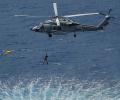
India, Japan and the Unoted States on Friday kicked off their marine war games, Malabar Exercise, close to the South China Sea as they focus on deeper military ties and greater interoperability amid rising tensions in the region.

The top diplomats of Quad nations on Friday denounced as "inadmissible" any use or threat of use of nuclear weapons in the Ukraine war and strongly opposed any "unilateral actions" that seek to change the status quo in the South and East China Seas, a region that has witnessed increasing Chinese military offensive.

As disputed South China Sea witnesses increased Chinese influence, Vietnamese Prime Minister Nguyen Tan Dung on Monday pitched for India's "active support" to peacefully resolve all disputes and sought its greater linkages across the region.

Beijing clearly intends to extend the China-Myanmar Economic Corridor to Bangladesh as part of its larger Maritime Belt and Road Initiative to boost its Indian Ocean presence.
'The worst case scenario is for China to behave like a bull in China shop, and brazenly and wantonly indulge in further encroachments, create obstacles to free navigation and convert SCS into an Air Defence Identification Zone.'

Prime Minister Narendra Modi addressed the Indonesian parliament, emphasising India's commitment to development over expansionism and advocating for a free, open, and inclusive Indo-Pacific. He highlighted the strong historical ties between India and Indonesia, calling for enhanced cooperation in various sectors, including defence, technology, and counter-terrorism, amidst growing concerns over regional security.

Ever since the Quad started taking shape in 2007, China has been saying that the four-member grouping will be bound to fail. But much to the chagrin of Beijing, it picked up pace in the recent years emerging as a premier strategic group especially challenging China's assertiveness in the disputed South China Sea.

Vietnam is an emerging regional power and a closer relationship with Hanoi is closely aligned with Prime Minister Narendra Modi's Act East Policy, points out Dr Rajaram Panda.

President Donald Trump is hosting a lavish state dinner for Chinese President Xi Jinping at the White House. The event, meticulously prepared by First Lady Melania Trump, features a unique blend of American and Chinese culinary traditions, a historic toast, and a star-studded guest list including top tech and business leaders. The evening will also include musical performances and decor reflecting Chinese cultural significance.

With East Asian countries remaining locked in a tussle over mineral-rich South China Sea, India today said the dispute should not override the interests of the region and favoured an "open, inclusive and rule-based" architecture to govern the maritime region

The Beijing summit may have reduced immediate diplomatic uncertainty, but it did not resolve the deeper structural contest between the United States and China. That contest appears likely to define the coming decade, notes Varun Arya.
